
3 core communication assets in the B2B Buyer Journey
In high-consideration B2B selling, purchase decisions involve multiple stakeholders, a higher trust threshold, and long evaluation cycles. It is difficult for a single content format to answer every question a buyer has throughout the decision-making process. While businesses use many communication assets, blogs, whitepapers, and case studies are among the formats commonly used and often used interchangeably.
Each of these formats, however, serves a distinct purpose. When used together, they help educate buyers, establish credibility, reduce uncertainty, and support decision-making throughout the B2B buyer journey.
This article explores the role of each communication asset in the context of B2B buyer journeys and how to write them effectively.
A typical B2B buyer journey
Before looking at what makes each communication asset effective, it helps to understand how B2B buyers typically move through a purchase decision.
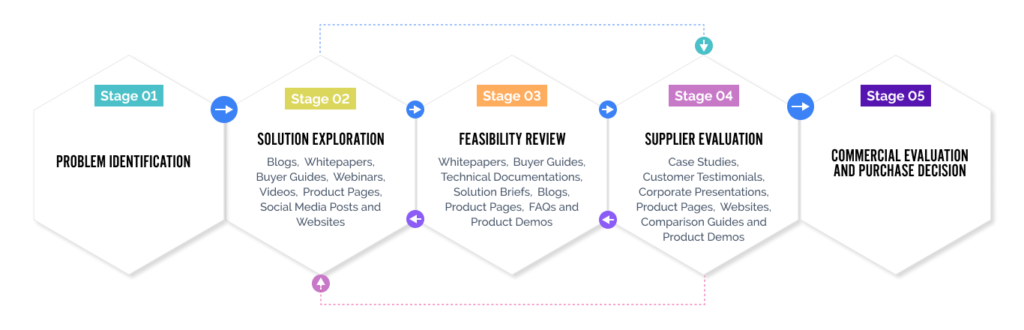
B2B buyer journeys usually go through five stages, but buyers rarely consume content in a linear sequence. B2B prospects often consume 8 to 13 pieces of content before engaging with a solution provider.
They may undertake several rounds of online research, download multiple whitepapers, request repeat demos, or revisit supplier websites during the decision-making phase (Stages 2, 3, and 4).
Because buyers frequently revisit earlier stages and compare multiple vendors, every blog, whitepaper, and case study becomes another opportunity to influence their decision – to make a choice, or at least come close to making one.
What does each format help you achieve
71% of prospects prefer independent research over talking to a sales representative. This means every piece of your content should speak for you.
Blogs
Blogs are ideal for creating awareness. Publicly accessible and built for reach, a good blog ranks strongly on search and AI engines, generates traffic, earns visibility, and opens the conversation.
Whitepapers
Whitepapers are a powerful thought leadership content format. Long-form, well-researched, and fact-based, whitepapers help showcase expertise and establish topic authority. They serve as lead magnets to nurture prospects, and also support sales conversations further down the funnel.
Case Studies
Case studies are a strong format for social proof content. They offer specific evidence of outcomes: an actual client, a real-world challenge, and a measurable result. This helps organisations earn trust through proof, and helps buyers see how a solution has delivered value in a real-world setting.
Writing effective B2B blogs
Globally, approximately 7.5 million blogs are published each day. Simply publishing another article is therefore just not enough. A strong B2B blog answers a specific buyer question, demonstrates expertise, and gives readers a reason to continue engaging with your business.
A good blog…
- focuses on one well-defined (and ideally narrow and specific) topic
- addresses a specific audience and the questions they are likely to ask
- optimises for search engines using relevant keywords
- is updated periodically to maintain relevance
- includes a clear conclusion and a relevant call to action
Writing effective B2B whitepapers
A whitepaper is a long-form thought leadership asset that enables organisations and subject matter experts to share their in-depth knowledge and expertise on a specific topic. It establishes topic authority, builds thought leadership, and demonstrates expertise through well-researched, evidence-based insights.
A good whitepaper…
- begins with a concise executive summary that frames the problem and introduces the topic
- prioritises internal knowledge and primary research by your own subject matter experts, supported by information from recognised authorities and industry sources
- uses visuals to improve readability and break up dense sections of text
- balances technical depth with readability. As a guideline, keep the document between 8 and 20 pages
- helps generate qualified leads by being gated behind a short form where appropriate
Writing effective B2B case studies
Case studies help buyers answer one important question: Has this solution worked for an organisation like mine? The strongest case studies therefore keep the customer’s journey and measurable outcomes front and centre.
A good case study..
- focuses on the customer’s challenge before introducing the solution
- explains the solution implemented along with measurable outcomes
- clearly demonstrates what changed from “before” to “after”
- includes customer testimonials, quotes, or videos to strengthen credibility.
- follows a logical flow to guide the reader through the story – for example:
Title → Client Intro → Challenge → Solution → Outcome
Mot Juste: Your extended B2B communication team
At Mot Juste, we believe every communication asset deserves to be written with a clear objective and backed by credible research.
This could be a blog that explains a complex subject without making it feel heavy. Or a whitepaper that gives a technical audience enough depth to trust the argument. Or a case study that helps the sales team demonstrate value in a way that feels relevant and credible.
A well-written piece of collateral, backed by strong thinking, credible research, and a clear purpose, helps buyers make informed decisions throughout their journey.
Content performs best when every communication asset is created with intent. If you’d like to align your communication strategy with your business objectives, we’re just a conversation away.